Address
312-F E. Market St.
Leesburg, VA 20176
Work Hours
Monday to Friday: 8AM - 5PM

Address
312-F E. Market St.
Leesburg, VA 20176
Work Hours
Monday to Friday: 8AM - 5PM
Regulatory agencies are responsible for protecting public health across food safety, drug safety, environmental exposures, and emerging threats. The volume and complexity of data – genomic, environmental, toxicological, exposure-based—have grown exponentially.
Cognizance’s scientific teams have supported FDA centers by developing actionable models that reduce uncertainty and enhance regulatory decisions.
Regulatory scientists face major barriers:
1. Highly heterogeneous datasets – Genomic, environmental, toxicological, and clinical data are difficult to harmonize.
2. Lack of standardized predictive workflows – Different FDA centers use different modeling practices, slowing adoption.
3. Limited translational models – Traditional animal and in-vitro tests often lack predictive power for real-world behavior.
4. Data overload for outbreak and exposure investigations – Investigators can be overwhelmed by thousands of genome sequences, environmental samples, or exposure scenarios.
There was a need for validated predictive analytic tools that are standardized, interpretable, and directly useful for FDA regulatory staff.
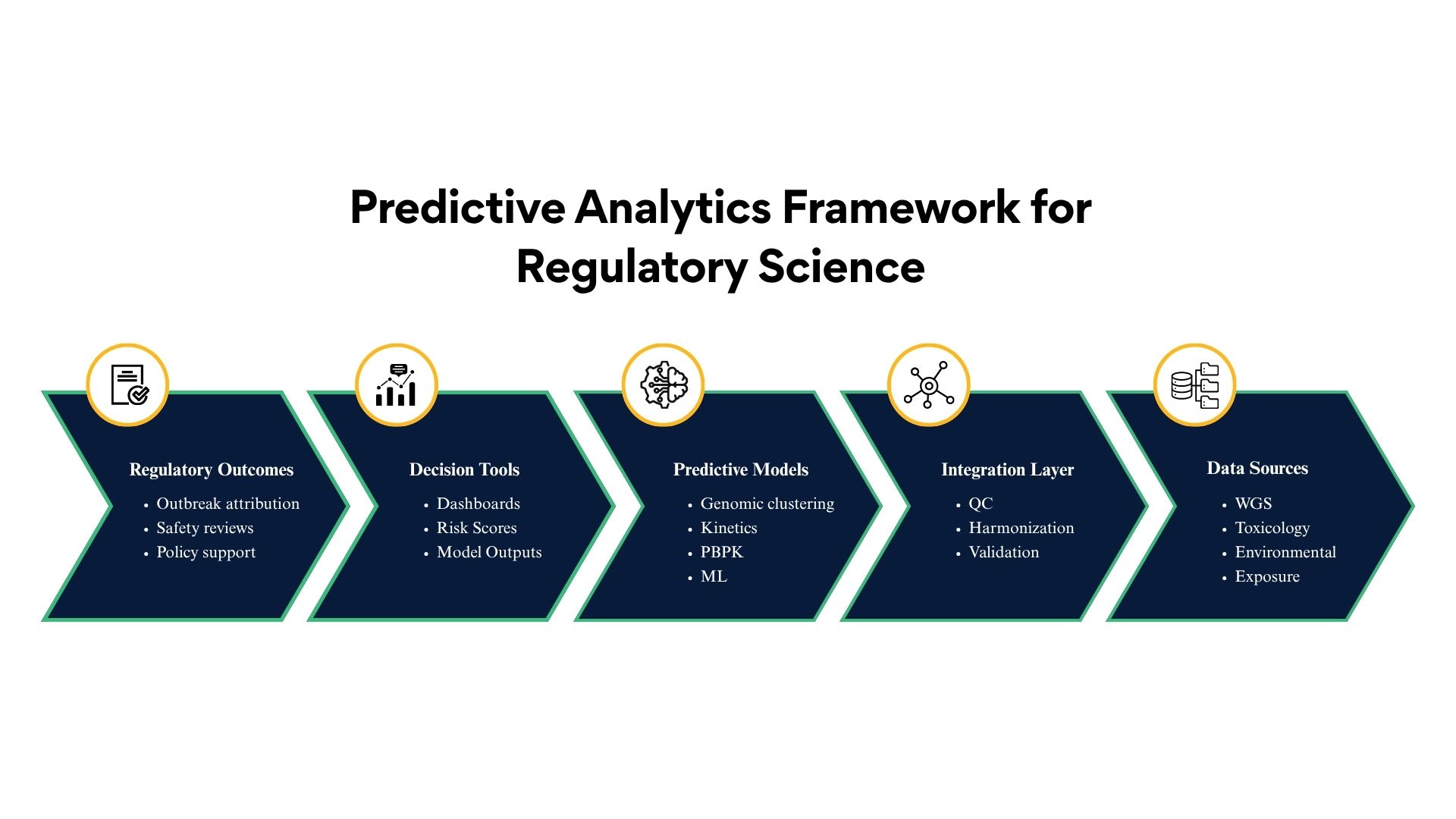
Cognizance’s scientistic teams developed a suite of predictive tools and analytics frameworks, supported by peer-reviewed publications:
1. Genomic Analytics for Food Safety
Impact areas: outbreak response, contamination traceback, environmental monitoring.
2. Predictive Microbial Risk Models
Impact areas: FSMA risk assessments, inspection prioritization, prevention strategies.
3. Quantitative Exposure and Toxicity Models
Impact areas: drug safety evaluations, chemical risk assessments, emergency pharmacology.
4. Machine Learning & Best Practices for Predictive Systems
Impact areas: regulatory harmonization, model validation, cross-center consistency.
The predictive analytics programs enabled:
✔ Faster outbreak attribution – WGS-based models reduced time to identify contamination sources.
✔ More accurate food safety risk assessments – Survival/growth models powered quantitative risk assessments for high-risk commodities.
✔ Improved drug safety insights – PBPK models provided mechanistic understanding of opioid exposures and countermeasure effectiveness.
✔ Enhanced environmental monitoring – Predictive models identified airborne microbial transmission pathways near agriculture facilities.
✔ Greater regulatory confidence – Standardized modeling frameworks increased reproducibility and transparency—key for regulatory adoption.
These analytics tools are now key components of ongoing FDA scientific support.